Redesigning How a $2 Trillion Industry Buys Ocean Freight
The first index-linked contract simulator in the world - and the design work that turned a complex commercial mechanism into a product customers across the ocean freight market actually use, then into an AI-informed portfolio platform.
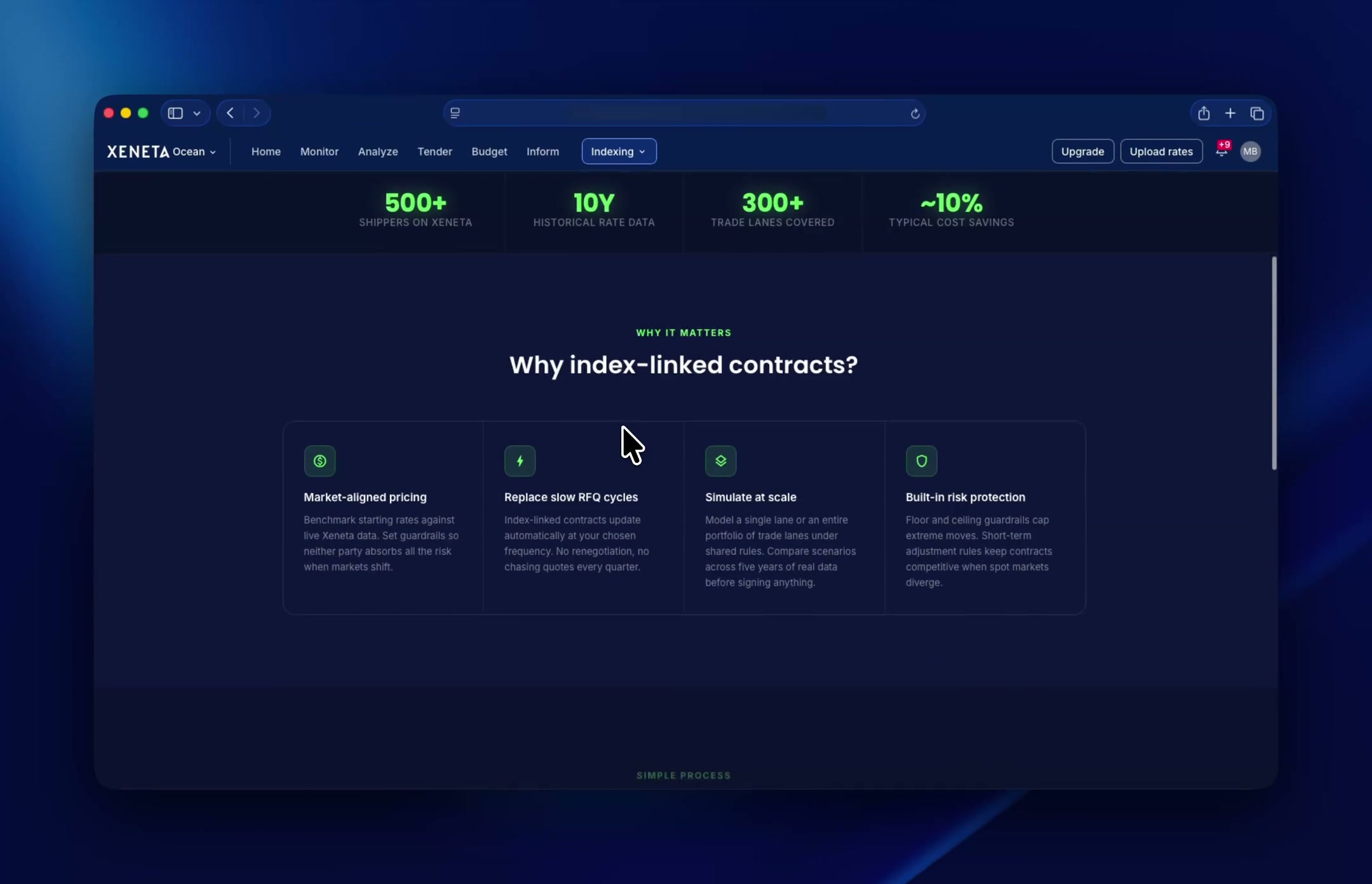
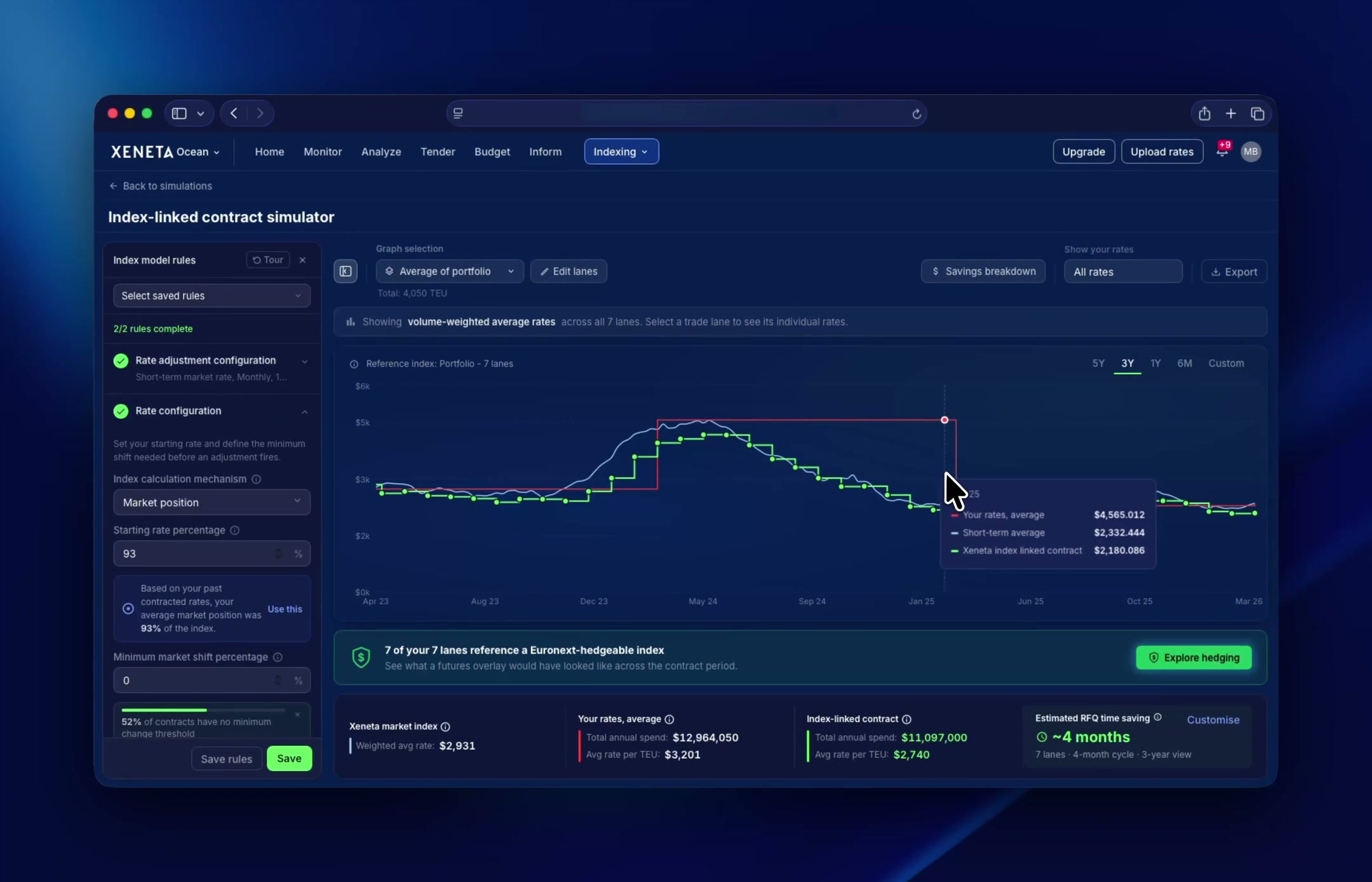
Xeneta Indexing today - the V2 platform this case study builds up to. The story of how it got there starts below.
The Challenge
Ocean freight runs on annual fixed-price contracts that take months to negotiate. When the market moves, the contracts stop working, and the supply chain breaks.
Index-linked contracts solve this by tying rates to a market index, so pricing moves with the market instead of being locked in at the wrong moment. The mechanism works. The problem is that it's complex, unfamiliar to most of the industry, and built on commercial judgement calls that customers need to feel confident making.
My job was to design a product that made those judgement calls navigable rather than intimidating: the first index-linked contract simulator in the world, built to turn indexing from a niche capability into something customers across the market would adopt.
Two decades of global events sending ocean freight rates spiking and crashing - the volatility a fixed annual contract can't keep up with.
Research & Discovery
I led discovery with the people closest to the problem: customer success managers, who spend the most time explaining indexing, and freight forwarders, who use the Simulator to validate the approach with their own customers. We also analysed how existing index-linked contracts in market were configured to understand which parameters customers were really using.
I ran user-testing sessions directly with shippers, including Walmart and Philips, watching how their procurement teams reasoned about indexed pricing and pinpointing exactly where the mechanics lost them.
One insight kept surfacing: customers trusted Xeneta's data, but not always the mechanics behind it. They believed the benchmarks were accurate. They struggled to understand how an indexed price would actually behave over time, what triggered a rate adjustment, or how to defend the mechanism to their own stakeholders.
That reframed the work. Transparency mattered more than automation. The product needed to make complex pricing logic explainable, not hide it.
I believe your benchmark. What I can't picture is what happens to my rate the day the index jumps.
Ocean procurement lead · Walmart
I can't walk into my CFO's office with a formula. I need to show them what it would have done to last year's budget.
Logistics procurement · Philips
The mechanism is probably fair. But if it goes wrong, it's my name on the contract, and I can't defend maths I don't understand.
Procurement manager · shipper, user testing
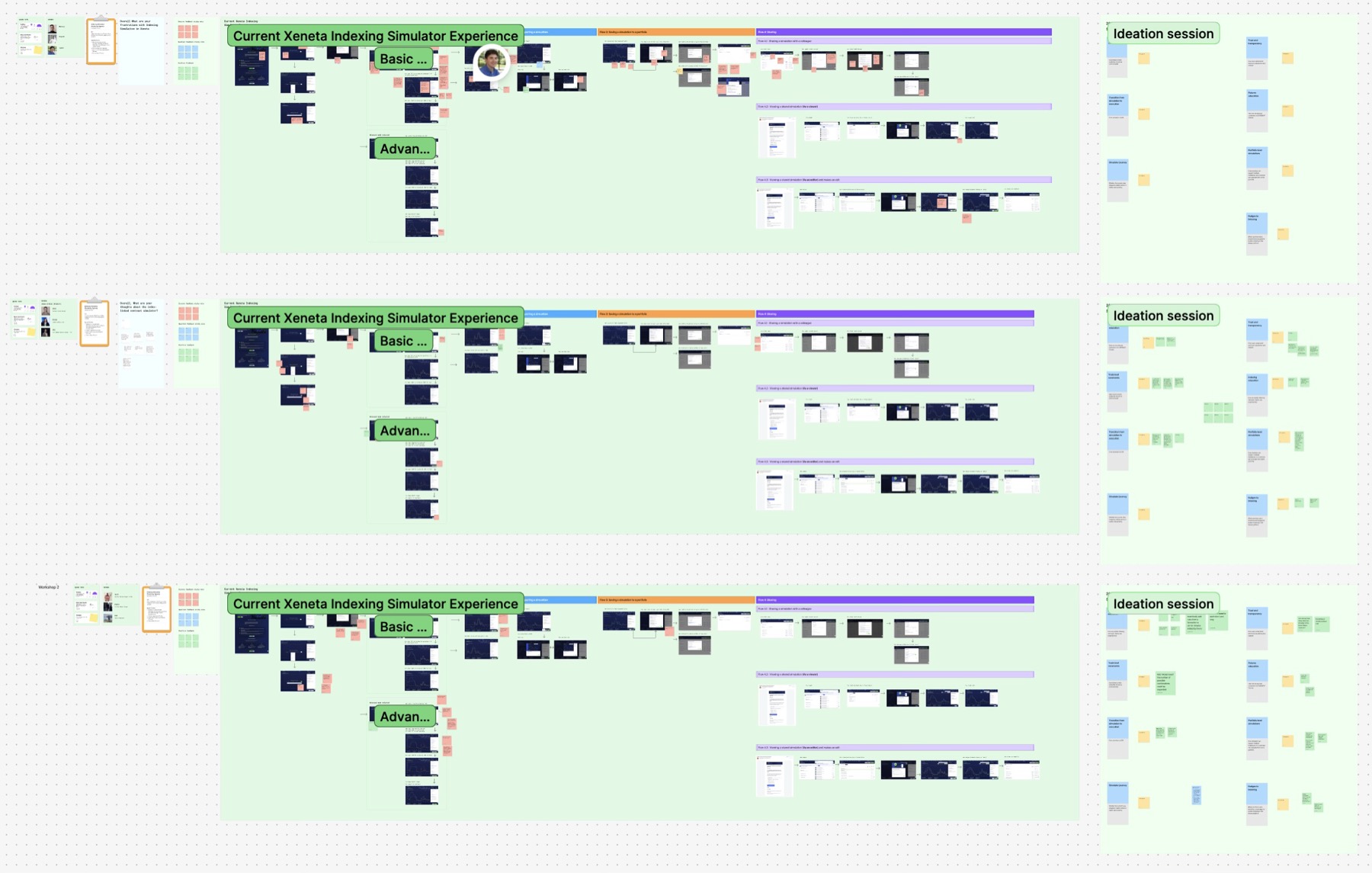
Workshop synthesis: mapping the current Simulator experience and ideating against it, session by session.
From research to product strategy
The workshops surfaced a more fundamental question than how to design any single screen. Customers were entering the world of index-linked contracts from completely different starting points. Some wanted to test the idea before committing. Some had already signed contracts externally and needed somewhere to operationalise them. Some were already running indexed contracts using Xeneta data and needed to monitor them.
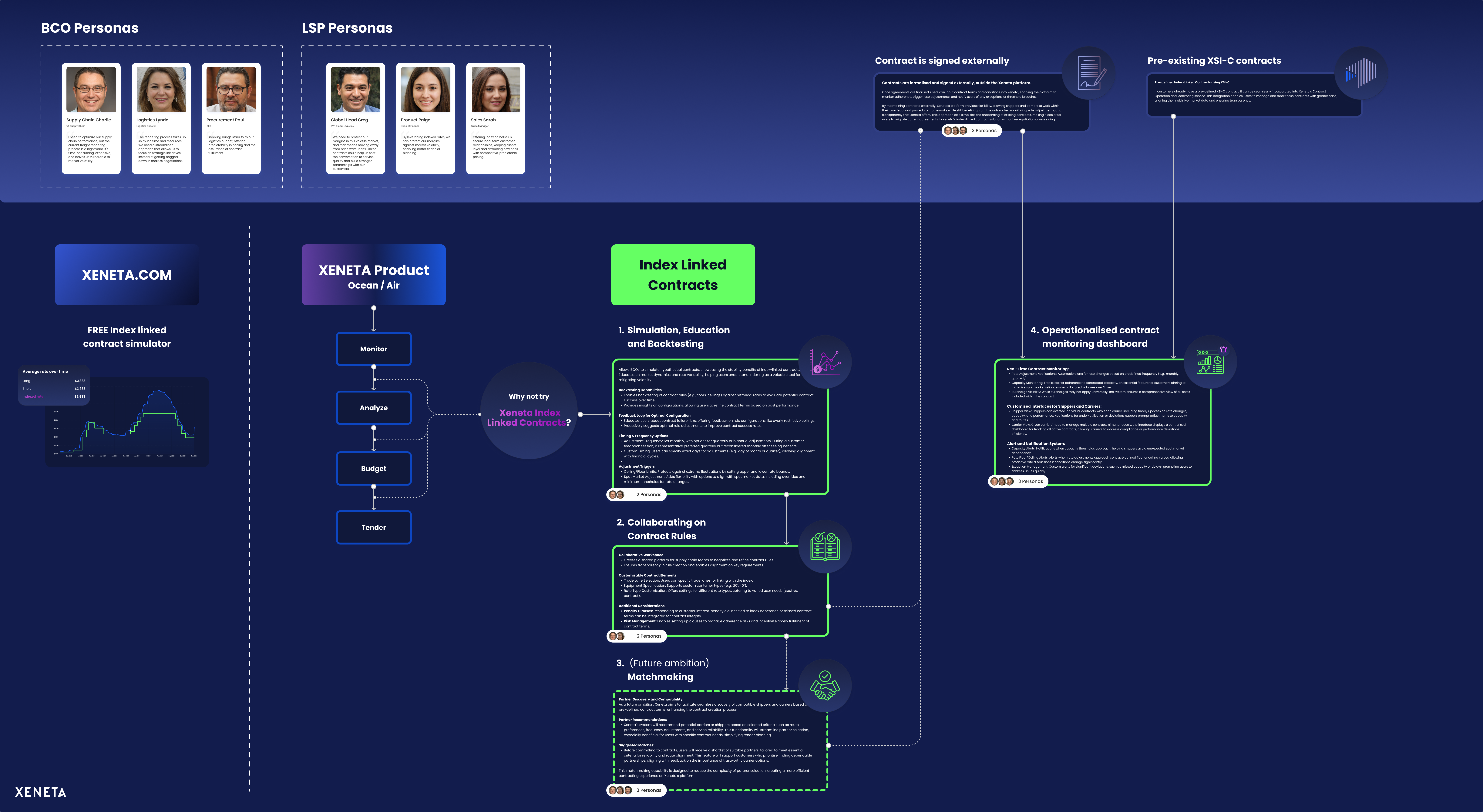
I synthesised the research into a product architecture that mapped these journeys end to end: who the personas were, where they came in, and how the surfaces needed to connect. This became the artefact I used to align product, commercial, and engineering on what we were actually building and in what order.
Two decisions came out of it. The first was to launch a free, standalone simulator as the front door. Letting customers backtest the idea without commitment was the lowest-friction way to build understanding, and the simulator could prove value before any contract was on the table. The second was to design the simulator and the live contract manager as one connected system, so the trust built in simulation could carry into operation rather than being lost at handover.
The simulator is the surface this case study focuses on, and the one that won the award. It's also the surface that opened the door to everything else.
A product architecture mapped from workshop research, showing how different customers enter the indexing journey and where the surfaces needed to connect.
Design Decisions
How trust gets built: the Maersk workshop
I ran a workshop with Maersk in Copenhagen - the largest container shipping company in the world, and one that already uses Xeneta's data and sells index-linked contracts to its own customers. The goal was to understand how their procurement managers actually pitch and configure these contracts in the real world.
Two things stood out. The first was how they go to market. Their teams don't sell indexing by handing customers a finished contract. They walk customers through the choices: which index to reference, which contract rules to accept, how aggressive a discount to take, how often to re-rate, where to set the floor. The deliberate act of making those choices, together, is what gets the customer to sign. It's how trust gets built.
The second was how they were doing it. The world's largest shipping company was modelling these contracts by hand, in Excel. The commercial mechanism was sound; the tooling was a spreadsheet. That was precisely the gap the Simulator existed to close.
Together those findings gave me a clear principle. The product should feel like the sales conversation, not skip past it. The user owns the decisions. The product brings the data, the historical context, and the ability to test what those decisions would actually mean. Configuration is where confidence is built. The visualisation and backtesting are where it pays off.
The workshop that reframed the product: Maersk, Copenhagen.
We never open with a finished contract. We make the choices with them: which index, how deep the discount, where the floor sits. Signing is the last step of a conversation, not the first.
Contract procurement manager · Maersk
We put the spreadsheet on the screen and model their own lanes, live. Watching the number move against their history is what convinces them. Not the brochure.
Contract procurement manager · Maersk
A customer is ready when they can explain the contract back to us. If they can't, it dies at their next internal meeting, whatever they signed.
Senior procurement manager · Maersk
The tenets of Indexing
Transparency beats simplification. Customers defending a decision to their own boss don't want a black box. They want to be able to explain it.
Feel like the sales conversation. The product walks through the choices the way Maersk does in the room. It never skips to the answer.
The user owns the decisions. The product brings the data, the history and the consequences. The judgement calls stay with the customer.
Trust must survive the handover. Simulation and operation are one system, so the trust built at the front door carries into the live contract.
Written after Copenhagen, before any screens. Every design decision that follows argues from one of these.
Prototyping in code, not slides
I built functional prototypes in code rather than relying on static mockups for stakeholder and customer reviews. It changed how the work landed.
Customers could interact with the work in sessions instead of imagining it, which produced sharper feedback. Engineering had something concrete to align against, which surfaced technical realities earlier and prevented scope from drifting late. Several decisions, including which features to defer, came out of conversations that wouldn't have happened over a Figma file.
The V1 simulator: a full walkthrough of the product that shipped and won the award.
V1 Outcome & recognition
Since launch, the Simulator has run 1,500+ simulations across 660+ users at 250+ customer companies, with sustained monthly engagement and adoption across every part of the freight market it was designed for.
The product question I started with was whether design could make this mechanism trustworthy enough for customers to adopt. The usage data says it could. Indexing moved from a side bet to one of Xeneta's strategic surfaces, helping reposition the company from a benchmarking tool toward a strategic procurement platform.
The work was named Winner of the Ship Technology Excellence Awards 2025 and a Finalist at the UX Nordic Awards (Future Product Days) - in under two years, from an unfamiliar commercial concept to an award-winning, widely adopted product.
A short launch promo for the simulator.
Listening at scale: an AI insights engine
V1 shipped and won awards, but it was deliberately simple: a single-lane simulator. To decide what V2 should be, I didn't want to wait on a handful of research sessions. I wanted to hear every customer who had ever talked about the Simulator. So I built the tool to do it.
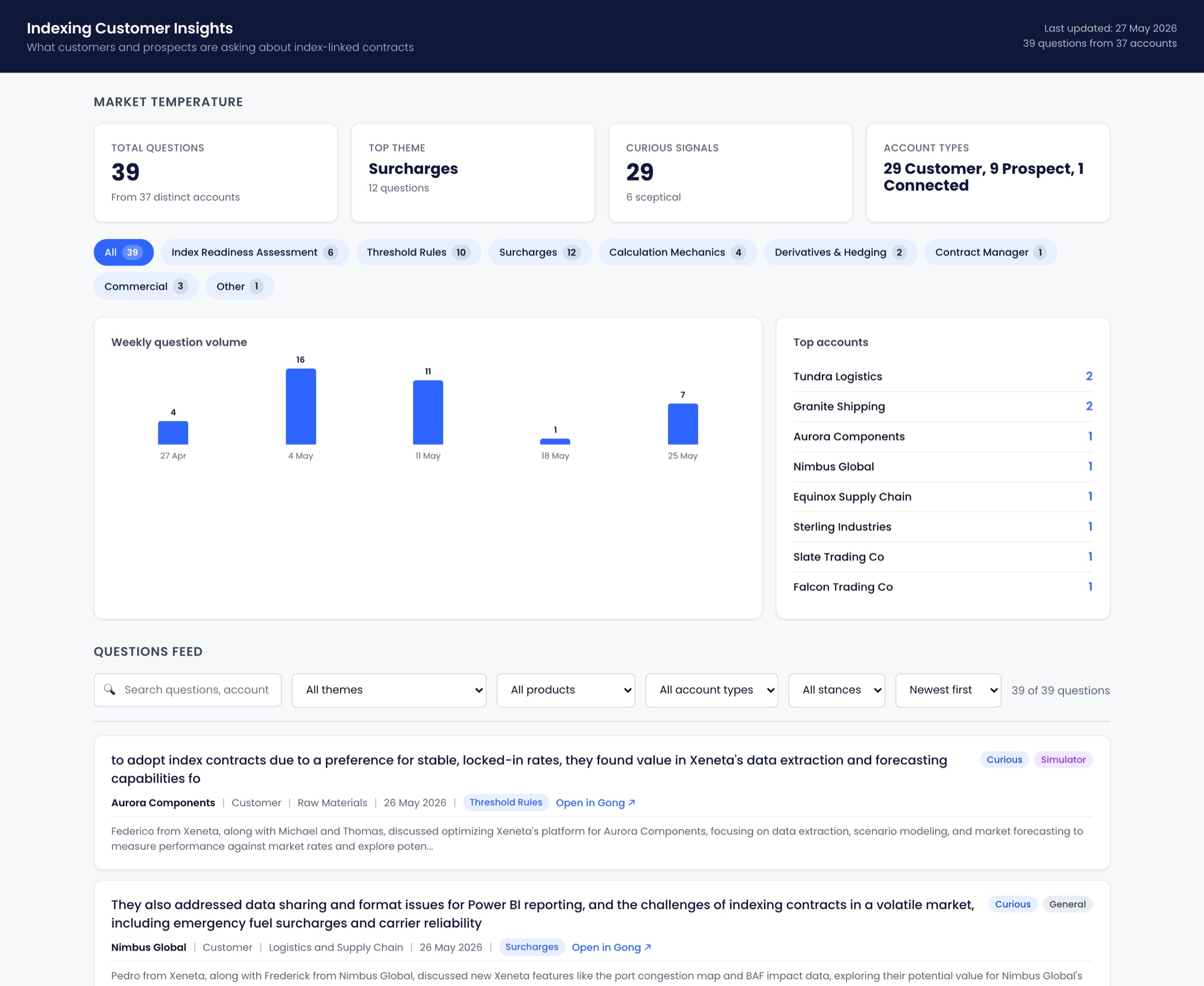
Xeneta's Customer Success and Account Executive teams record their customer calls in Gong. I built a pipeline that pulls the transcripts of those calls, finds every moment indexing comes up, and feeds each one through the Anthropic API. Claude extracts the new feature ideas and points of confusion, then classifies each by theme, by stance - curious, sceptical, confused - and by account type, with a link straight back to the exact moment in the call.
Across 700+ calls that mentioned the Simulator, that turned anecdote into evidence. Instead of waiting for the next research round, the design team had a continuous, queryable voice-of-customer feed: what customers actually asked for, themed, ranked, and traceable to its source.
This is the part I'm most proud of. Faced with a strategy question, I built my own research infrastructure to answer it - a designer using AI not to generate screens, but to listen at a scale no round of interviews could match.
The insights dashboard: customer questions pulled from Gong calls, classified by theme and stance, each traceable back to the exact moment in the call. (Account names anonymised.)
V2: from simulator to portfolio platform
The insights pointed one way. Customers didn't think in single lanes; they bought freight across whole portfolios, and the question they kept circling back to was how to protect a budget when the market moved. V2 answered both, with a multi-lane portfolio simulator and a Hedging Explorer.
None of it was change for its own sake. Each move answered something V1 - or the research around it - had surfaced.
V1 - the simulator
V2 - the portfolio platform
V1Basic and Advanced modes that split users in two and broke shared walkthroughs in live sessions.
V2A single guided, educational flow that teaches each rule as you configure it.
V1One trade lane modelled at a time.
V2A whole multi-lane portfolio simulated under one shared ruleset.
V1Model what an index-linked contract would have done.
V2Model it and hedge it, with the new Hedging Explorer.
V1Shaped by workshops and a handful of research sessions.
V2Shaped by AI analysis of 700+ customer calls.
V1SUS 75: solid, and above the 68 industry average, but the mode split put a ceiling on it in live sessions.
V2SUS 86 with the same users, once the guided flow made the walkthrough shared again. Anything above 80 is an A grade.
Multi-lane portfolio simulation
Instead of modelling one corridor at a time, customers can now build an entire contract book - adding trade lanes by origin, destination, equipment and volume, or importing them straight from a watchlist or CSV - and apply one set of indexing rules across all of them. The simulator backtests the whole portfolio against five years of real Xeneta data, including the COVID and Red Sea disruptions, so a procurement lead can see how their book would actually have behaved before signing anything.
One ruleset, an entire contract book: multi-lane portfolio simulation backtested against five years of real market data.
The Hedging Explorer
Modelling a contract tells you what your pricing would have done. It doesn't protect you from it. The Hedging Explorer adds that next step: futures and derivatives guidance that lets a customer hedge a contract as well as simulate it.
Research had flagged futures as powerful but risky to surface broadly - there is a line between guidance and financial advice that a data company can't cross. So the tool leads with education. It establishes the customer's position (buying or selling freight), explains hedging in plain English, checks which lanes are actually hedgeable against the listed Euronext futures corridors, then lets the user dial in how much of their volume to cover with a single slider, surfacing the average rate they'd lock in and how much exposure they'd remove. It is explicit throughout that it is guidance, not financial advice.
The Hedging Explorer, end to end: position, a plain-English primer, hedgeable lanes, and the coverage that locks in a rate.
Branding Xeneta Indexing
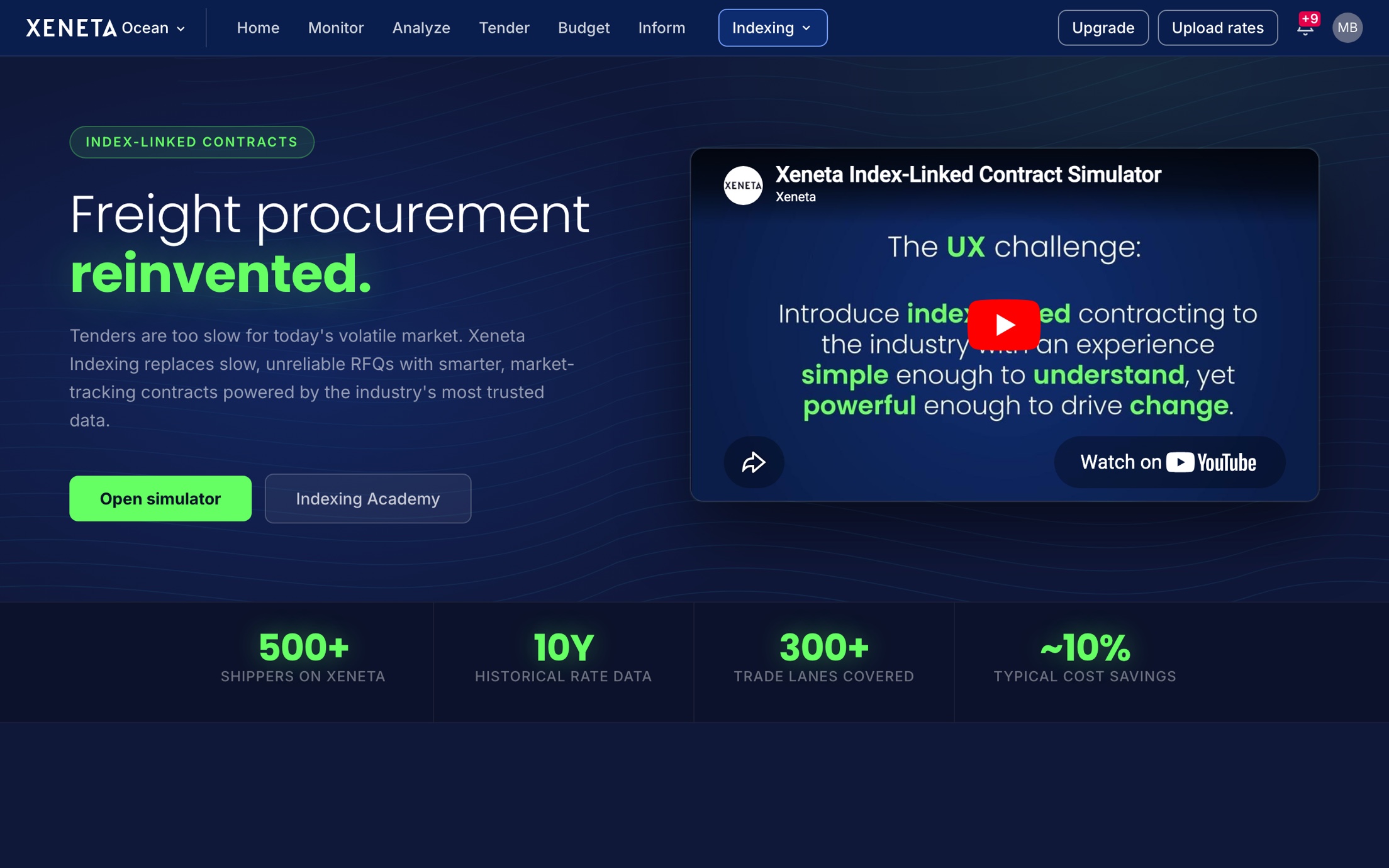
For indexing to be taken seriously as a strategic bet, it had to look like a product line, not a feature buried inside the platform. Alongside the product work, I shaped the visual identity for Xeneta Indexing: a consistent look across the simulator, the marketing surface, and the academy content that sat around it.
It had to do two things at once. It needed to feel distinct enough to stand on its own, while sitting comfortably inside Xeneta's parent brand. That meant working within the existing guidelines on type and colour, then giving indexing its own accent and language so a customer could tell, at a glance, that this was a new class of product.
The result gave the whole programme a single, coherent face - the same identity carrying customers from the marketing page, into the free simulator, and on into their live contracts.
The Xeneta Indexing marketing surface - a distinct identity that still sits inside the parent Xeneta brand.
What I learned
Trust is a UX problem. In enterprise products, especially financial ones, transparency is more valuable than simplification. Customers making commercial decisions don't want a black box. They want visibility, confidence, and the ability to defend the result to someone else.
The best product research happens where the product isn't. Watching how a sales team actually sells indexing taught me more about how the simulator needed to feel than any usability test could have. Domain authority belongs with the user, and the product's job is to bring the data, the context, and the patience to let them work it out.
AI can be research infrastructure, not just an output tool. The most valuable thing I built for V2 wasn't a screen - it was the pipeline that let me hear 700+ customer conversations at once. Using AI to scale listening, rather than to generate artefacts, changed what evidence the design team could work from. I think that's where a lot of the craft of senior design is heading.
Results
World first
First index-linked contract simulator in the world